
History at North Ferriby
The Core Christian values at North Ferriby Church of England Primary School are Courage, Friendship, Perseverance and Respect. These values underpin our curriculum and enrich all aspects of our pupils’ education. Our curriculum prepares children for the future by developing Heathy and Safe, Trusting, Enterprising and Creative members of the local community. Embedded within our teaching and learning are opportunities for the pupils to understand the meaning and significance of the Christian faith.
At North Ferriby Church of England Primary School, History is taught in a meaningful and vibrant manner which brings events and historical concepts to life. Where possible, the history curriculum makes use of rich resources within the immediate and wider local area enabling children to develop an understanding of the history of their locality. Topics are informed by the national curriculum and the curriculum is carefully planned and structured to ensure that current learning is linked to previous learning. In line with the National Curriculum 2014, the curriculum aims to ensure that all pupils:
- Gain a coherent knowledge and understanding of Britain’s past and that of the wider world which helps to stimulate pupils’ curiosity to know more about the past
- Are encouraged to ask perceptive questions, think critically, weigh evidence, sift arguments, and develop perspective and judgement
- Begin to understand the complexity of people’s lives, the process of change, the diversity of societies and relationships between different groups, as well as their own identity and the challenges of their time.
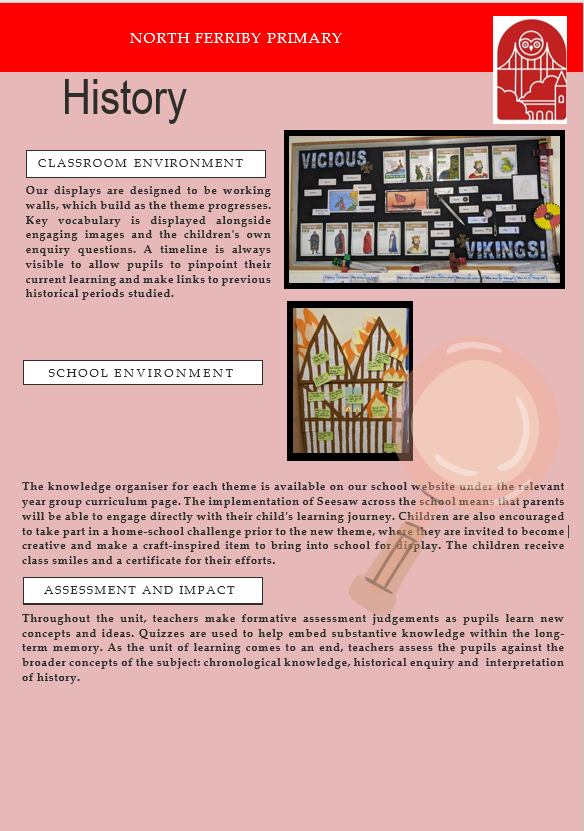
The Teaching of History Through a Structured Process
Our History curriculum uses the National Curriculum aims as a basis for our curriculum planning in history, integrating a sequential development of knowledge whilst developing a range of skills and expansion of vocabulary across all key stages.
Overarching curriculum themes are planned through the school with specific historical themes detailed in the History Long Term Plan (LTP). These themes and associated objectives form the Scheme of Work for each year group ensuring a basis of retrieving and developing knowledge as detailed in the History Progression documents.
This ensures that the our scheme of work identifies what pupils already know before outlining the new learning in the next stage of the learning journey. Children will use their knowledge about the past (substantive knowledge) and their knowledge about how historians investigate the past and how they construct historical claims, arguments and accounts (disciplinary knowledge). These are detailed through the year group’s knowledge organisers.
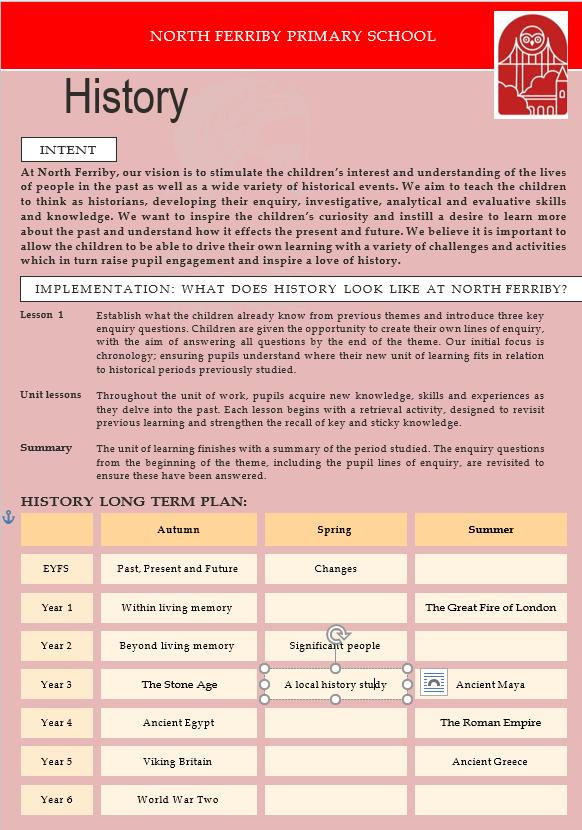
Scheme of Work Structure
Lesson 1
Establish what the children already know from previous themes and introduce three key enquiry questions. Children are given the opportunity to create their own lines of enquiry, with the aim of answering all questions by the end of the theme. Our initial focus is chronology; ensuring pupils understand where their new unit of learning fits in relation to historical periods previously studied.
Unit Lessons
Throughout the unit of work, pupils acquire new knowledge, skills and experiences as they delve into the past. Each lesson begins with a retrieval activity, designed to revisit previous learning and strengthen the recall of key and sticky knowledge.
Summary
The unit of learning finishes with a summary of the period studied. The enquiry questions from the beginning of the theme, including the pupil lines of enquiry, are revisited to ensure these have been answered.
Although we work thematically, we are careful to ensure every subject is distinct and that the skills and knowledge specific to that subject are taught. All topics have a half termly knowledge organiser (examples can be seen on this page) which pick out the key knowledge we want the children to learn.
We baseline test the children before each topic and then after each topic to see what has been learnt and address any misconceptions or gaps in learning. SEND pupils , where appropriate, are pre taught sticky vocabulary and key concepts.
We expect the children to talk confidently about different subjects and to be able to articulate prior knowledge , making links to other subjects across the curriculum.
Ever lesson focuses clearly on subject specific knowledge and vocabulary which is displayed on classroom walls and on knowledge organisers.


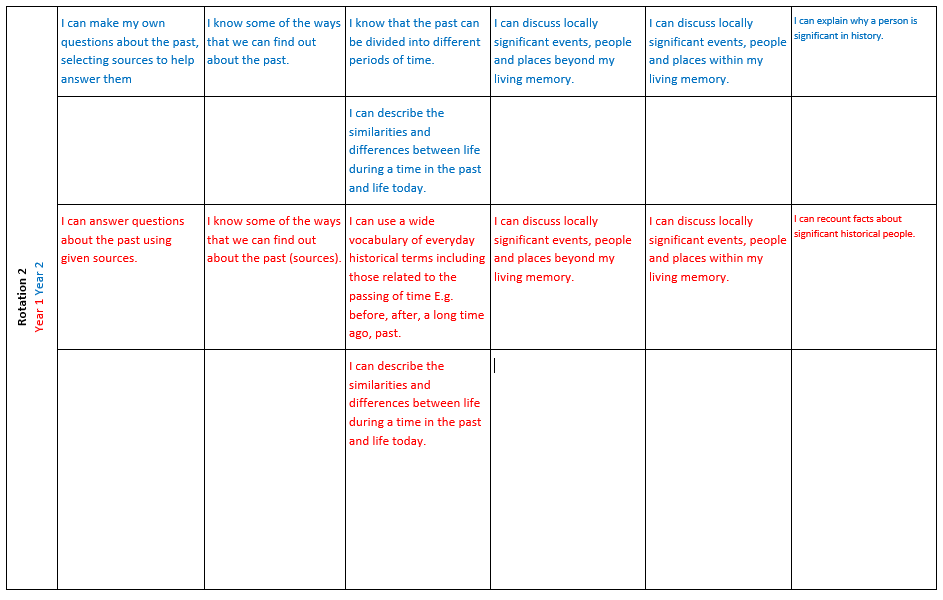
Progression of Knowledge through the Year Groups



Impact of History at Ferriby
Our pupils study the past through a range of different timescales. They have the opportunity to learn about a range of historical places, societies and cultures. Their studies build on established knowledge, vocabulary and enhances their knowledge by referencing other time periods, deepening their understanding (Romans – Vikings invaders).
Our children learn about a range of different types of historical enquiry; social, political, economic and cultural history. Our curriculum prepares pupils for life in modern Britain and supports pupils to make sense of their own experiences and identity within their local community, Britain and the world.
“I enjoyed the visit to Merton Park and living like a Roman”
“I enjoyed learning all about Amy Johnson and aeroplanes through the years”
“It was very hard living times for the British population during and after WWII, as rationing was introduced in January 1940 and lasted until 1954.”
“I particularly enjoyed eating Greek food!”
